Capacity is often the first number discussed when buyers compare recycling equipment, yet it is also one of the easiest numbers to misunderstand. A quotation may show kilograms per hour without stating the material, feed size, moisture, contamination, final particle size, operating time, or test method behind that figure. Reliable plastic recycling line capacity must be connected to a defined production condition.

1. Replace one capacity number with an operating envelope
A useful specification defines several conditions instead of one maximum. State the normal throughput, short-term peak, minimum stable rate, expected hours per shift, shifts per day, and days per year. Then describe the exact input and required output for every condition. This creates an operating envelope that suppliers can design and test.
For plastic recycling line capacity, the word “rated” should always have a reference point. Is it the crusher feed rate, clean product leaving the mill, material entering a storage silo, or packaged output? A line can move a large mass into the first machine while producing far less acceptable product at the end.
2. Describe the incoming material as it actually arrives
Accurate plastic recycling line capacity begins with an input-material table. Record polymer, dimensions, thickness range, maximum single-piece weight, bulk density, temperature, moisture, contamination, metal risk, labels, films, fibers, and percentage of oversize pieces. Include normal variation rather than presenting only the easiest material.
3. Define the required output before selecting equipment
Throughput is valuable only when the discharged material is suitable for its next use. Specify target particle size, allowable oversize, fines limit, temperature, residual contamination, moisture, bulk density, and the form in which output will be stored or transferred. A coarse regrind and a fine powder require different energy and residence time.
The required output determines plastic recycling line capacity because every extra reduction stage consumes time and power. A crusher may process large pieces quickly, while a downstream mill limits the amount that can be converted into a narrow powder specification. The line guarantee must include the output standard, not simply machine rotation speed.
4. Build a mass balance for the complete line
A mass balance follows material from receiving to acceptable output. Begin with feed mass and allocate it to finished product, oversize return, metal removal, foreign material, filter dust, cleaning waste, floor loss, and material remaining inside equipment. The total should reconcile within an agreed tolerance.
For example, feeding 1,000 kilograms during a test does not prove plastic recycling line capacity of 1,000 kilograms per hour. If 60 kilograms remain in silos and conveyors, 25 kilograms enter dust containers, and 35 kilograms fail the output specification, only 880 kilograms have become acceptable product during that period.
5. Find the bottleneck under real conditions
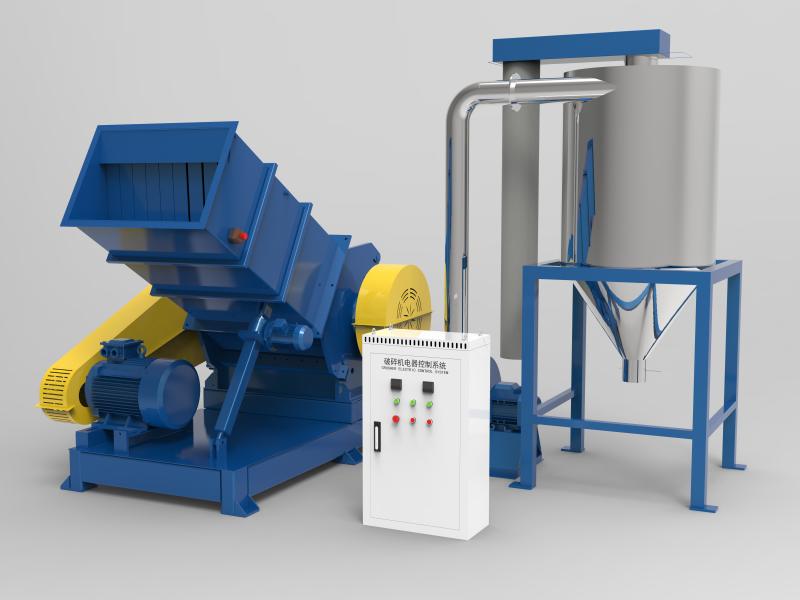
Weshaw’s PVC crushing and milling solution shows a process that can include belt conveying, vertical crushing, screw conveying, buffer storage, controlled feeding, rotary milling, and dust collection. When estimating plastic recycling line capacity, each interface needs a compatible design rate and enough control range.
Create a bottleneck table for the proposed plastic recycling line capacity. List every stage, its design basis, minimum and maximum rate, motor load limit, control method, surge volume, and recovery behavior. Ask the supplier which stage limits each test material and how that conclusion was calculated or demonstrated.
6. Convert machine ratings into line performance
Individual machine ratings cannot simply be added or copied into a line guarantee. A crusher rated under continuous, uniform feeding may perform differently when pieces bridge in the hopper. A mill may reach its nominal output only with a specific feed size and stable metering. Conveyors must handle both mass flow and actual bulk volume.
To predict plastic recycling line capacity, check the conditions behind every component rating. Confirm material, rotor or cutter configuration, screen opening, feed method, motor power, usable chamber width, discharge arrangement, and allowable temperature. Identify where the supplier has used test data and where it has used an assumption.
7. Account for bulk density and irregular feeding
A stable plastic recycling line capacity needs controlled feed presentation. Long items may require alignment, bulky pieces may need pre-cutting or shredding, and flexible scrap may need anti-bridging geometry. The loading method should protect operators while keeping the first machine supplied at a repeatable rate.
8. Include screens, cutters, wear, and temperature
The guaranteed plastic recycling line capacity should state the cutter condition and screen specification used for testing. Buyers should also ask for the expected operating range before maintenance is required. A guarantee based only on newly installed wear parts may overstate average monthly performance.
9. Size dust extraction as production equipment
Dust collection is part of the process, especially in crushing and milling applications. Insufficient airflow can release fines, overload filters, contaminate bearings, or restrict product movement. Excessive airflow may remove useful powder or increase filter loading. Duct routing and airlock performance also influence stability.
For plastic recycling line capacity, specify which materials create dust, expected fine fraction, airflow, filter area, cleaning method, hopper discharge, and permitted pressure range. Ask how the system responds as filters load. A dust collector that works for a short demonstration may not maintain the same performance through a complete shift.

10. Calculate availability, not only hourly output
If the plastic recycling line capacity is 800 kilograms per running hour but the line operates productively for only 75% of a 16-hour day, expected daily output is 9,600 kilograms before yield loss. Using 800 multiplied by 16 would overstate usable production by 3,200 kilograms.
Build three cases for plastic recycling line capacity: conservative, expected, and proven. Each case should show running rate, availability, yield, shifts, and product mix. This is more useful for budgeting labor, storage, utilities, spare parts, and downstream consumption than a single optimistic figure.
11. Check utilities at peak and normal load
Connected motor power is not the same as actual energy consumption, but it determines electrical infrastructure. Request a motor list, starting method, simultaneous-load case, expected running load, voltage tolerance, compressed-air demand, cooling demand, and extraction airflow. Include conveyors and auxiliaries, not only the main machines.
Utilities can restrict plastic recycling line capacity. Low voltage, insufficient cooling water, unstable compressed air, or inadequate extraction can force slower feeding or repeated stops. The supplier should state utility conditions required for every guaranteed test and identify protection logic when those conditions are not met.
Energy comparison should use acceptable output. Divide measured energy by kilograms of in-specification product, not by feed mass. This lets buyers compare plastic recycling line capacity and energy intensity without rewarding a faster line that produces more rejects, overheated powder, or uncontrolled fines.
12. Use surge storage to separate process stages
Buffers allow adjacent machines to operate despite short variations in feed or discharge. They can reduce nuisance stops and keep a mill supplied evenly. However, a silo that is too small empties quickly, while an oversized silo can hide problems, increase retained material, complicate cleaning, or permit segregation.
For the intended plastic recycling line capacity, calculate usable buffer mass from bulk density, hopper geometry, high and low level settings, and material flow behavior. Then convert that mass into minutes at normal and peak rates. State whether the buffer must support controlled shutdown, changeover, or temporary downstream interruption.
The control narrative should explain how level signals change equipment speed. A well-tuned plastic recycling line capacity strategy slows upstream equipment before overfilling and protects downstream equipment from starvation. Alarm delays and restart rules should be tested, not left for operators to invent after commissioning.
13. Run representative material trials
Material testing is most valuable when the sample represents difficult production. Include the thickest, largest, lightest, most contaminated, or most heat-sensitive material expected in normal use. If several input groups will be blended, prepare the trial in the correct proportions and loading condition.
The trial plan for plastic recycling line capacity should state sample mass, feed preparation, screen and cutter configuration, measurement points, warm-up period, test duration, sampling frequency, and output criteria. Short bursts can demonstrate peak rate but cannot establish stable hourly performance, filter behavior, or temperature equilibrium.
Weshaw also presents dedicated SPC and LVT flooring recycling and plastic pipe and sheet recycling arrangements. These examples show why plastic recycling line capacity must be linked to material geometry and process route instead of transferred from an unrelated application.

14. Write a measurable FAT and SAT
The factory acceptance test should verify safety functions, operating sequence, alarms, direction of rotation, interlocks, no-load condition, and loaded performance. For the capacity run, define who supplies material, how it is prepared, where it is weighed, which instruments are used, and who approves the results.
Test plastic recycling line capacity over a long enough interval to reach stable conditions. Record input mass, acceptable output, oversize, dust, waste, retained material, energy, temperatures, motor loads, interruptions, and reason codes. Preserve samples and photographs when particle-size or appearance requirements matter.
The site acceptance test should repeat critical checks after installation. Foundations, electrical supply, ducting, conveyors, operator practices, and upstream or downstream equipment can alter plastic recycling line capacity. Record deviations, corrective work, retest rules, documentation, training, and the final signed result.
15. Compare commercial proposals on the same basis
Put every proposal into one comparison table. Include input envelope, finished-product specification, guaranteed running rate, yield, availability assumption, utility conditions, wear-part condition, included equipment, control boundary, dust system, installation scope, trial plan, and acceptance method. Mark every exclusion and unverified assumption.
A lower quoted plastic recycling line capacity may be more valuable if it is based on representative material, acceptable output, and a complete test. A larger unsupported number can lead to extra shifts, unfinished orders, excessive wear, or an unexpected second investment. Compare evidence and responsibility, not only the headline.
Use Weshaw’s project references to discuss similar materials and process routes. Ask which published configuration most closely supports the proposed plastic recycling line capacity, what changed between that project and yours, and which claims still require a new trial.
Frequently asked questions
Is crusher capacity the same as complete-line capacity?
No. The crusher is only one stage. Conveying, buffer storage, controlled feeding, milling, classification, dust collection, discharge, and packaging can limit the final rate. Complete plastic recycling line capacity should be measured at an agreed boundary using acceptable product.
How much test material is needed?
The quantity must be enough to fill the system, reach stable temperature and filter conditions, run for the agreed test period, and produce representative samples. Large lines may require several hours of material. Calculate the quantity from expected plastic recycling line capacity plus retained and rejected material.
Should capacity be guaranteed for every material?
Only when each material and output condition is defined. Different polymers, shapes, thicknesses, contamination levels, and final sizes create different duties. A separate plastic recycling line capacity should be agreed for every material group that has a meaningful effect on performance.
What data should appear in the acceptance report?
Record material identity, configuration, test duration, input mass, acceptable output, rejects, dust, oversize, retained mass, energy, temperatures, loads, downtime, samples, and calculation formulas. The report should make plastic recycling line capacity independently understandable after the test team leaves.
Turn throughput into a bankable production plan
Capacity becomes useful when everyone agrees on the material, output, measurement boundary, running condition, availability, and test method. A careful specification connects individual machine ratings to the behavior of the complete line and exposes the assumptions that require evidence.
Verified plastic recycling line capacity supports realistic production schedules, utility planning, labor budgets, storage design, and downstream commitments. Send Weshaw representative samples, photographs, material quantities, output specifications, layout, operating schedule, and acceptance targets so the proposed line can be evaluated against the duty your factory will actually run.